Chrome registers a global shortcut for Gemini popup window
69 points by skycam
69 points by skycam
Google stopped caring about user consent years ago, and chrome has always been a surveillance tool, so this really should not come as a surprise to anyone.
I understand what you’re saying, but that doesn’t make it OK. Every time we are able to point to specific transgressions and remind people how bad certain software are, I hope this convinces somebody else to not install the browser.
Every day Chrome moves closer to being the next IE6; so every day we get closer to its eventual demise.
I wasn't saying it was ok - I was saying that you can't trust google to use chrome as anything other than a vector to compromise the integrity of a device. From day one they explicitly enabled third party cookies, something that had been off by default in safari/webkit for the entirety of its existence, because it broke a bunch of their spyware.
Their own properties actively bypassed their own private browsing mode - I still refuse to believe that was unintentional, especially given their decision to actively support their privacy violating third party cookies decision.
In my experience when Google says privacy they mean other people/companies cannot directly access the information they have collected from you.
Google's decision to use gmail as a core tracking and spyware vector is why amazon and other companies no longer includes order details directly in most emails that they send.
Nobody says it's okay. The point is that Chrome has essentially become malware at this point, and that anyone who has the slightest clue about browsers should already be well underway with their mitigations, i.e. using alternatives like Firefox or Chromium based browsers that remove most of the malware. Chrome's user-hostile behavior and overall decline has been going on for years already.
Which Chromium based browser can I recommend to family and friends that doesn't exhibit user hostile behavior? Two major ones, MS Edge and Brave, are hostile too.
I find all of this complaining about Chrome from technical users odd. People talk as if Firefox doesn't exist. Its kind of like complaining about Windows.
Unfortunately, Firefox is full of "AI innovations" as well, but at least, it's easy to turn them off.
It is at least mozilla's current policy to provide opt-outs and user-customizability. Chrome is user-hostile and deliberately more locked down.
Mozilla's opt-out is useless. They rebrand everything under the sun as "AI" to please share holders, then provide a toggle to disable everything they have helpfully rebranded as "AI". Nobody who wants to disable "AI" wants to disable on-device machine translation of web pages for example. It's malicious compliance.
Waterfox has a much more reasonable policy.
That's not right. There is a "master switch" sure, but you also have options to disable every individual aspect. I personally have translation on and everything else off, because the rest doesn't provide me value. It'd only be malicious compliance if you had no such granular option.
The master switch is the malicious compliance.
As I recall there was a community poll on Mastodon that asked if on-device translation should count and the result was it should. People accused them of bad faith for implying it shouldn’t.
Do you have a link to that polll? I'd like to see the wording.
https://mastodon.social/@firefoxwebdevs/115849251057488746
For posterity:
Firefox uses on-device downloaded-on-demand ML models for privacy-preserving translation. They're not LLMs. They're trained on open data. Should translation be disabled if the AI 'kill switch' is active?
25% - Yes
49% - Yes, but let me re-enable just translations
22% - No
3% - 🤷
It also seems most of the responses aren't accusing bad faith for asking as such, but for putting the features in at all against feedback.
It’s surprising to me that translation isn’t an LLM. Last year I used it to translate a long list of student organizations with similar names from a school website, and it bugged out halfway through and just started printing “sports club, sports club, sports club, sports club,” ad nauseam. I guess ML has quasi-hallucination failure modes as well?
Yes, pre-LLM language models could get stuck on the same output. iirc (though less sure about this one because it's been a while) even Markov models can get stuck if the transition probabilities point it to the same state.
Firefox is pretty much a nonstarter. Their attitude toward their technical users is one of utter contempt and this mentality resonates in every decision they make.
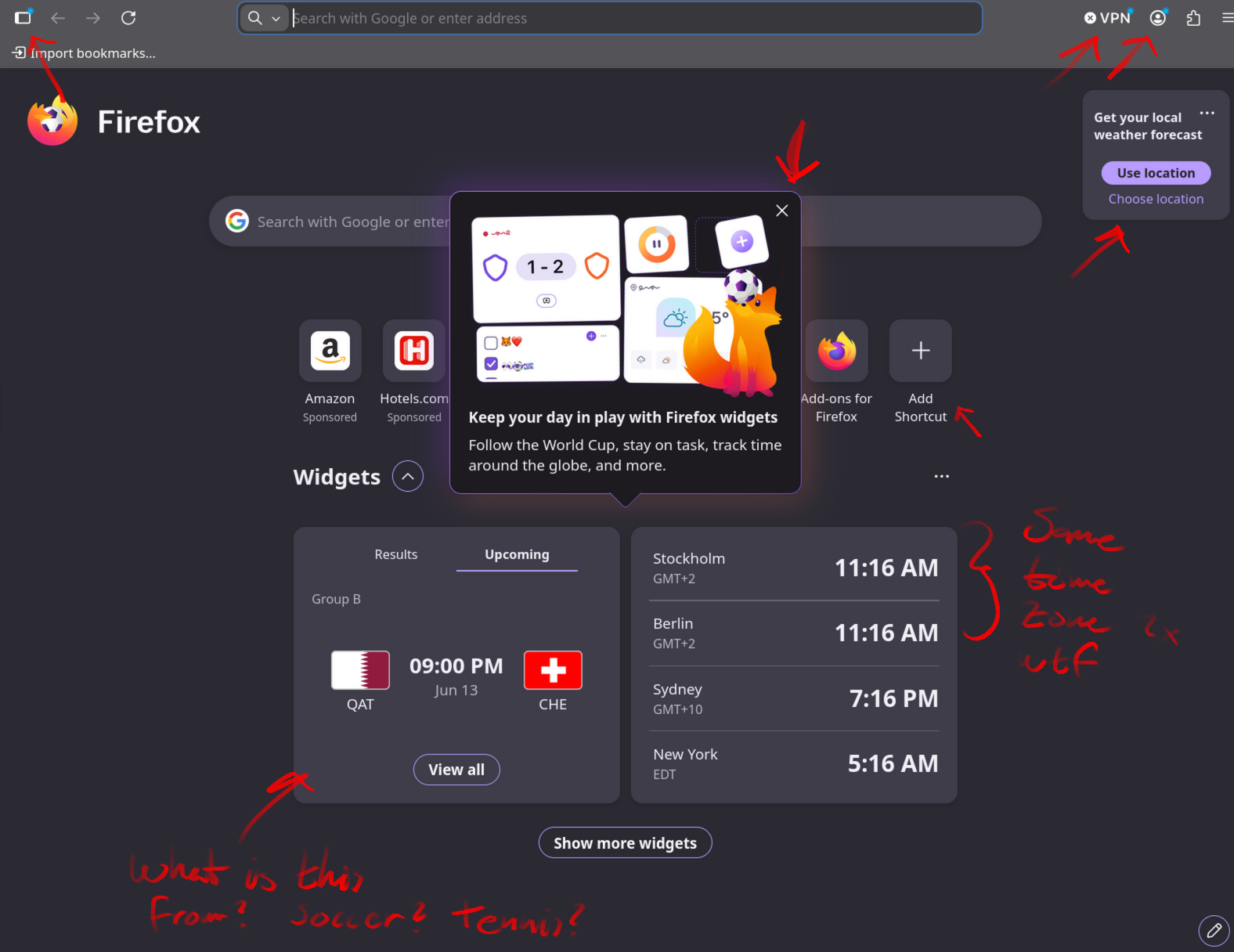
Their UX is also among the most obnoxious I think I've ever seen in any modern application. This is from another comment, but last time I opened firefox I was met with over half a dozen of calls to action pulling at my attention at the same time!
I'm genuinely curious how you come up with the idea of showing me a popup that tells me what I already see on screen below the popup. Just how little confidence do you have in your design ability when you resort to something like that?
Does it really matter that badly what you saw the first time you launched it? You saw some CTAs so the only viable non-spyware solution is now a "nonstarter"? Firefox could've goatse'd me the first time I launched it and I'd still be using it today - fundamentally, it's good software.
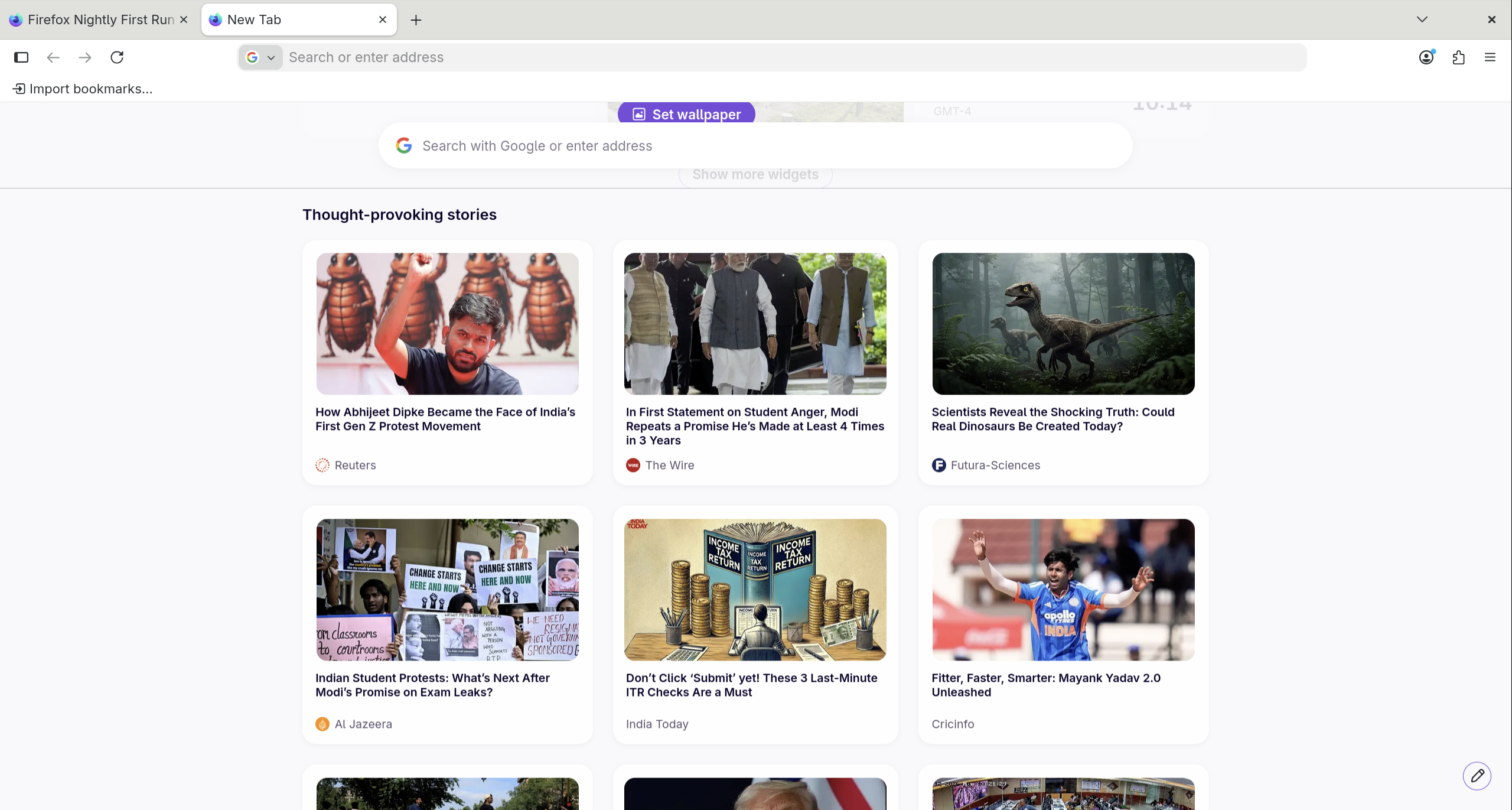
I just tried a fresh profile¹ and ouch, it’s become somewhat worse than I realised, though not quite as bad as in your picture, for whatever reason. Though there’s still the second page, which… yuck.
¹ mkdir /tmp/f; firefox-nightly --new-instance --profile /tmp/f; rm -r /tmp/f. I use this from time to time when checking if bugs exist in a fresh profile. But I am normally using it for a specific URL, and don’t visit about:newtab!
FWIW it seems to randomly throw different popups on subsequent starts. I've gotten a bunch of different calls to action fests by just closing and opening it.
The chum box in your second picture feels like something I'd expect to see in Microsoft Edge.
It’s pretty trivial to disable all that junk with the pencil button in the bottom right. In all the years I’ve used it, I think the only time they’ve messed with my preferences was when the World Cup score widget appeared last month.
When Firefox was relevant, it was because it immediately provided clear direct advantages that were impossible to ignore. Mind you, chrome was created taking its main ideas directly from Firefox.
The page inspector, greasemonkey, tabs, reducing the chrome (original meaning of the word) to the minimum necessary, all these were ideas that Firefox made mainstream.
These large projects need market share or they stay a tiny niche for a handfull of die hard neackbeards. You need to break the network effect barrier.
Firefox and Mozilla started to be all focused on politics and honestly a bit of virtue signaling, to the point that the technical yield was made secondary.
If i use Firefox only, it is a matter of a few days intill something needs to be tested in Chrome. Or to be honest, even if you use extensions, there is already a larger offer in Chrome.
Firefox even cannibalized its extension infrastructure to comply with inferior chrome standard.
Do you remember downthemall? 20 years have passed and here I am a couple of times per week wishing I had something like that. While it's not even possible to implement it even in Firefox these days.
So I don't agree with you. That Firefox exists is not enough. It would need to have a strong value offer that people use it for reasons other than ethics and politics.
Same with Mac. The guy's preferred keybinding was overwritten and he's writing a post about it, instead of owning his computer.
I can't imagine chrome or anything else overwriting my sway keybindings. Because every component and decision in the system knows it's place, and user stands at the top of the hierarchy.
"Instead of"? It sounds like he went into Chrome's settings and disabled the keybind, and then wrote a post complaining about it. I don't understand the problem.
I said "owning his computer".
Do you genuinely not see a reading of my comment where asking Chrome not to override his system keybinding does not constitute owning his computer?
You don't have to agree with my point or it's assumptions, but I'm sure you can understand what my point says.
What was puzzling for me is, he complains about a specific case of some hobo of a tool messing with his chosen setup, instead of complaining about that being allowed/acceptable on his OS in general. Like your home is vandalized, but your only problem is that the vandals chose bad color for a graffiti.
I also partly blame macOS for ceding its responsibilities here. Mac’s keyboard customization features are a mess, and Mac doesn’t have a modern command repository. [rest of paragraph continues to complain more about his OS…]
Programs being able to register global shortcuts is a good thing. It has been one of the major missing pieces in Wayland for a while, and is now finally implemented. Not everyone wants the answer to, "how do I enable push to talk?" to be "enter your system key binds settings and add a key bind to a discordctl shell snippet". The only problems here are this specific hotkey that Chrome added, without consent, and that macOS doesn't have a nice way to see which programs registered which global hotkeys.
An application should be able to offer a keybinding or a shortcut, but I don't think it should be able to quietly enable a global one. How the user is notified of that offered shortcut and whether he chooses to enable it is a responsibility of os, and should be entirely up to the user.
You should be managing global shortcuts in your DE settings, not in chrome settings.
On Wayland, or Linux generally, .desktop files are an alright way of offering things like push to talk. An app brings it in a package, your DE discovers it and offers in "global shortcuts" settings GUI.
Another related thing: mimetype associations. IMO the way they're done on Linux is not great. An app offers mimetypes it can handle in a desktop file — this is ok so far — but then some also change the defaults on first run. And we're back to windows trash behavior: you ran some tool once, now your file associations are off and you need to "open with" on them one by one to set them to what you're used to.
Everybody complains when Wayland won't let programs other than the compositor register global keybinds, but then this is what happens if your environment allows it.
Note that it doesn’t even identify itself as either Chrome or Gemini, unless you read the scary caveat.
This is also a problem for push notifications: someone has subscribed to a spam push notification, and you’re trying to help them get rid of such nonsense, but the notifications just come in with no obvious attribution, and it’s made worse by the way Chrome pushes “profiles”, so you can easily end up having to check half a dozen places (two or three browsers for unknown reasons, a couple of them with two or three profiles also for unknown reasons—and when I say “unknown” I mean that the user has no idea either—and the actual place you manage this stuff in at least Chrome is confusing too, the first place it looks like it should be just isn’t).
Let’s not beat around the bush: This is effectively malware behaviour.
Twenty years ago such behaviour was common in reputable software—browser toolbars and such. Everyone agreed it was awful, antivirus software slapped PUA (Potentially Unwanted Application) designations on, browser makers rearchitected in part to cut such possibilities out, and the problem went away.
Now Microsoft and Google are both doing it again.
Slap a PUA label on it again, antivirus software makers. I might almost respect you for a week or two.
<C-g> is important in Emacs. https://www.reddit.com/r/emacs/comments/1p0e67s/cg_high_jacked_by_gemini/ "With no warning chrome high jacked C-g globally on my Mac."
<C-g> doesn't seem to do much in neovim.
<C-g> doesn't seem to do much in neovim.
It's not super essential, no, but I do occasionally use it, especially 2<C-g>, which show the full path to the current file. I don't necessary know that at all times because I often open files by fuzzy-finding either the file name or some file contents, and in projects with identically named files in different folders this is occasionally confusing.
I'm very apathetic about software choices, but this has finally pushed me from Chrome to Firefox.