Why Don’t Lowercase Letters Come Right After Uppercase Letters in ASCII?
35 points by alpaylan
35 points by alpaylan
A decent explanation, but I felt that https://garbagecollected.org/2017/01/31/four-column-ascii/ does a better job; it's not just about shift but also ctrl; for example tab is ctrl-i because I is 1001001 and ctrl masks out the first bit leaving 0001001 for tab.
If you are using electromechanical logic, rather than electronic logic, as manufacturers did in the 1960's, then a bit paired keyboard is a lot easier to implement. The shift key just has to toggle one of the bits in the ASCII character.
Today we just put a general purpose CPU into every keyboard, and logic is free, but that solution was a lot more expensive in the era when general purpose computers were the size of a room.
At least the letters are continuous in ASCII, EBCDIC have a spacing of 0x40 (64), but compared to ASCII EBCDIC have two lines of 9 and one of 8 on top of each other.
Some of the 6-bit character codes that preceded EBCDIC were pretty weird as well https://en.wikipedia.org/wiki/Six-bit_character_code#Examples_of_BCD_six-bit_codes
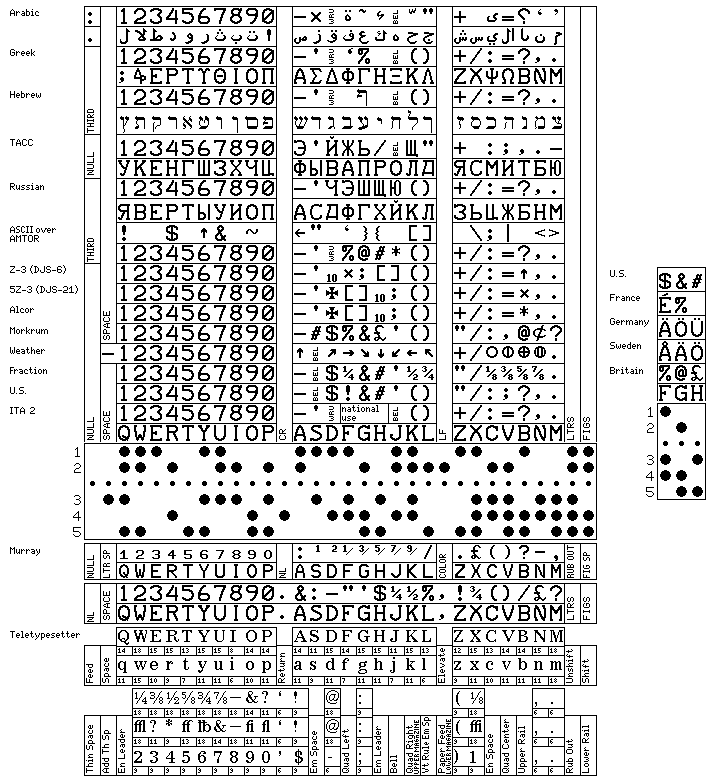
The less said about 5-bit codes http://www.quadibloc.com/crypto/images/tele38.gif and IIRC some CDC peripherals which used a 6-bit code with lots of page-shift controls the better.
Your examples of 5 and 6 bit codes, with page shifting, are a lot simpler than Unicode, where 1-4 UTF-8 code units make a code point, and up to a dozen or more code points are combined, using a nested grammatical structure, to make a single Emoji symbol (aka extended grapheme cluster), in accordance with a constantly changing specification that will seemingly never stabilize, and whose complexity is accelerating over time.